Dynamic Load Management
Smart load management systems designed to prevent electrical overloads, balance residential power demands in real time, and eliminate the need for expensive main service panel upgrades.
- Application Scope Residential & Multi-Family
- Compliance Level NEC 625 & 705 Verified
- Hardware Technology Smart CT Sensors & Modbus
- Protection Status Zero Breaker Tripping
Intelligent Energy Distribution Without Service Upgrades
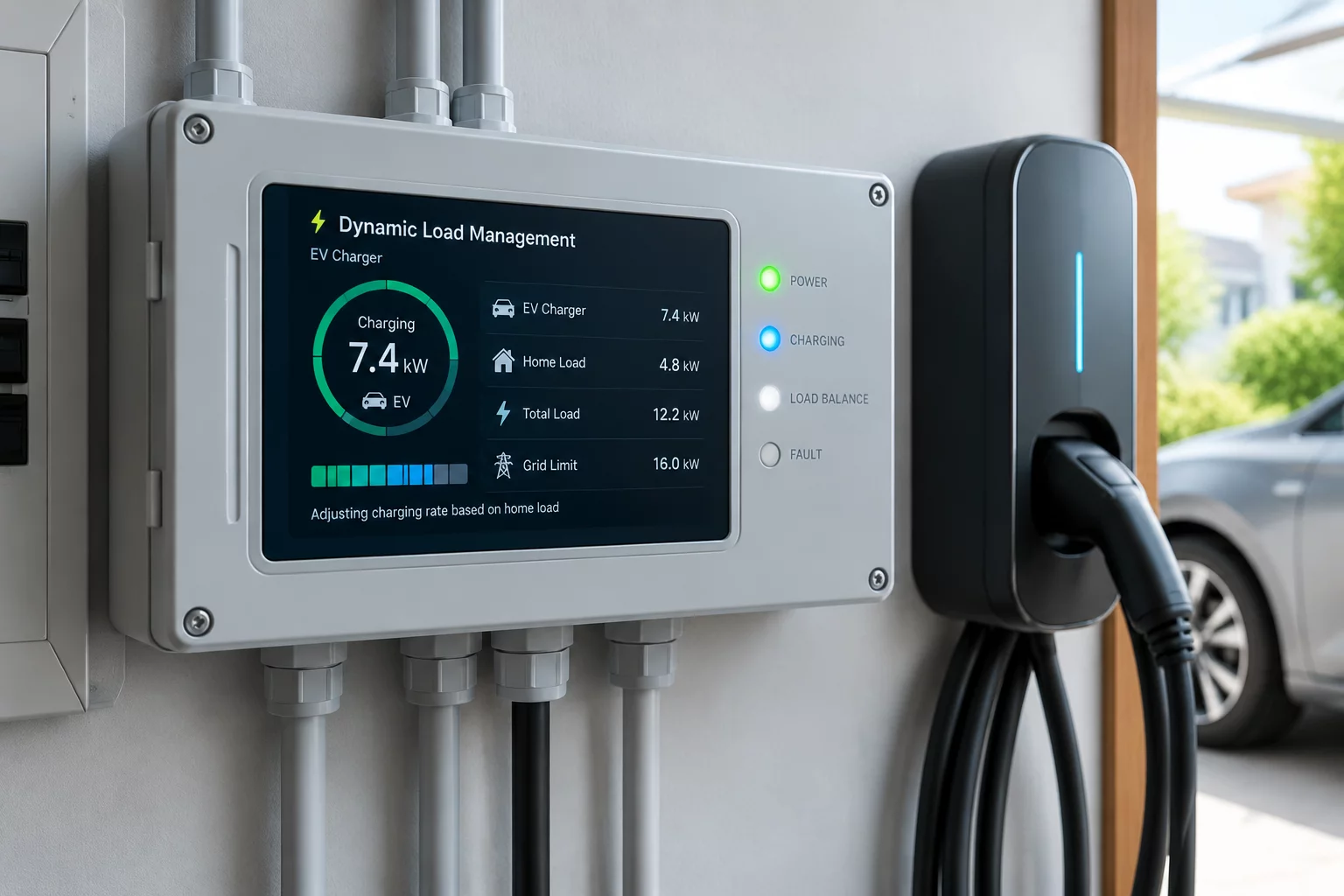
Adding a dedicated Level 2 EV charging station often pushes older 100A or 150A residential service panels near their maximum safe capacity. When multiple high-draw appliances operate at once—such as heat pumps, ovens, water heaters, and air conditioners—charging a vehicle at maximum continuous wattage can risk tripping the main breaker or violating electrical code allowances. Dynamic Load Management (DLM) solves this dilemma by installing active current transformers (CT clamps) and intelligent energy controllers directly at your main panel.
Technical Engineering & Execution
The DLM system monitors home power draws millisecond by millisecond. When domestic energy consumption rises during evening peaks, the load balancer communicates instantly with your smart wallbox to automatically throttle charging output down to a safe threshold. As household appliances turn off overnight, the controller safely ramps charging speeds back to full amperage. This real-time modulation allows EV owners to extract the maximum possible charging rate whenever headroom exists.
- Dedicated continuous duty circuit design and panel inspection
- High-amperage industrial conduit routing with zero structural impact
- Smart dynamic load balancing configuration to prevent grid overload
- Complete municipal permit acquisition and final utility sign-off
Results & Long-Term Reliability
Homeowners who implement dynamic load management avoid thousands of dollars in utility service entrance rebuilds and eliminate months of bureaucratic permitting delays. Your vehicle charges at maximum efficiency whenever energy is available, your electrical infrastructure remains strictly protected against overcurrent, and your home electrical system stays 100% compliant with all local safety standards.
| Power Output Configuration | 1.4 kW to 22 kW Adaptive Modulation |
|---|---|
| Breaker Amperage | 40A - 60A Dedicated with CT Integration |
| Conduit Routing Distance | Shielded Cat6 / RS485 Hardwired & Wi-Fi |
| Load Management System | Continuous Real-Time Current Transformer Sensing |
| Enclosure Weatherproof Rating | NEMA 4X / IP65 Indoor & Outdoor Rated |
Dynamic load controllers are commissioned per NEC 625.42 energy management provisions, with fail-safe fallback amperage and certified CT metering accuracy.